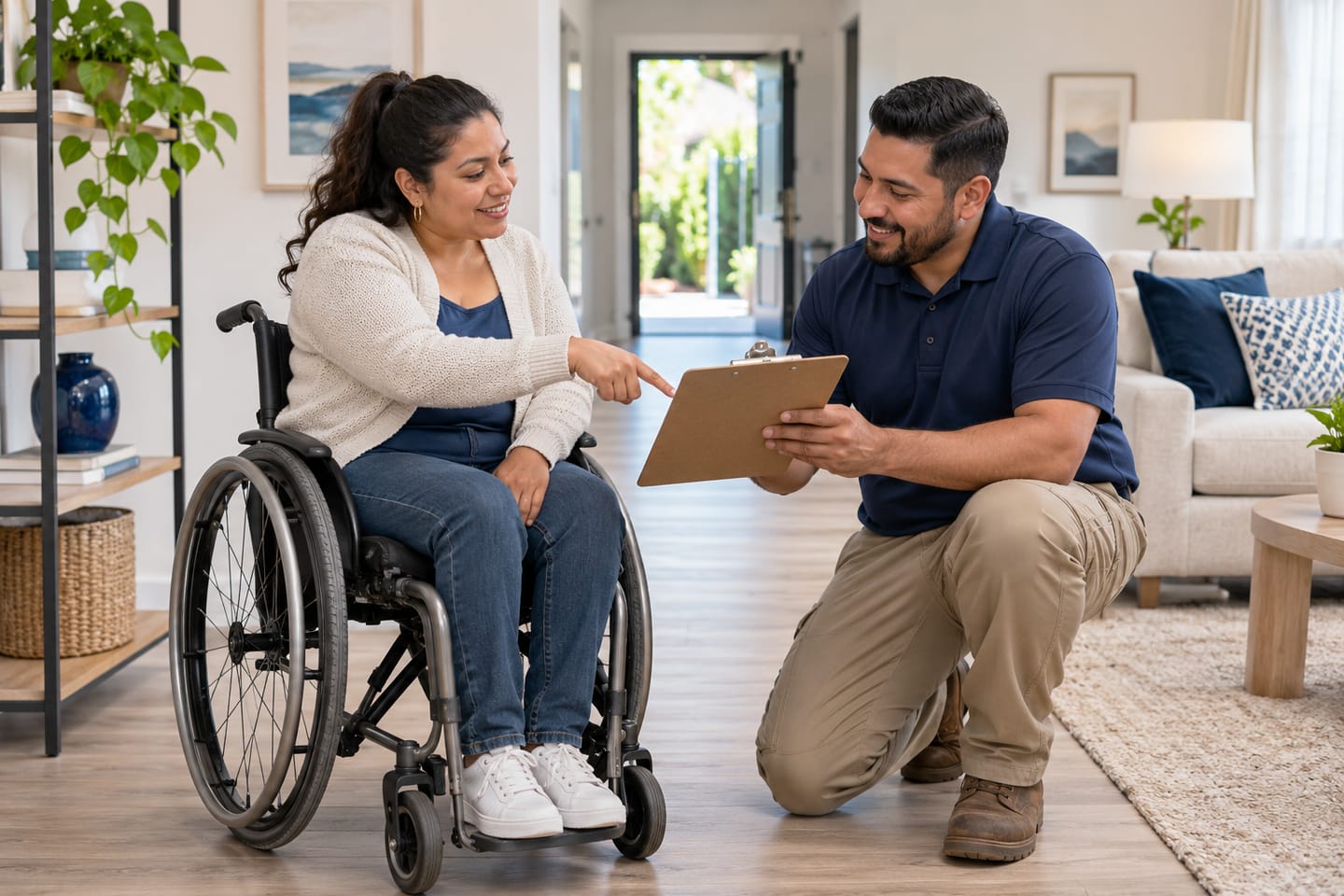
A service visit can change how a household moves through its home. Equipment in a hallway, furniture moved for cleaning, or an appointment that blocks the only usable entrance can turn a straightforward task into a difficult day.
Discuss access and communication needs before confirming the visit. The person who uses the space should guide that conversation; a business or relative should not assume what help is wanted or which route is suitable.
Agree on how the household will use the space while work happens. Share practical requirements without disclosing personal information that the service does not need.
Start with the person's priorities
Ask what needs to remain available during the appointment. That might include a route between rooms, a particular entrance, a seating area, a bathroom, or space around mobility equipment. Use the person's description rather than imposing a standard checklist.
Identify who will discuss the work and make decisions. If a family member or support person is helping, clarify their role and include the person receiving the service in the conversation as they prefer.
Keep the request focused on the appointment. You can explain that a route must remain clear or that a written update is needed without providing a diagnosis, detailed medical history, or unrelated household records.
Describe the route and the work area
Tell the business about doorways, stairs, lifts, parking, and the path to the service area. Ask what space its equipment needs and where it expects to put tools, hoses, protective materials, or removed items.
Identify routes that must stay usable and ask whether the proposed process can maintain them. Do not wait until the crew has unpacked to discover that the only passage will be blocked for the full appointment.
If the work cannot be performed with the requested route open, discuss alternatives before booking. That may mean a different work sequence, a smaller scope, a different appointment arrangement, or choosing another provider whose process fits the home.
Agree on communication before arrival
Explain how the business should announce arrival and who should receive the message. Confirm whether a call, text, doorbell, or another agreed method works for the household and what happens if there is no response.
Ask for explanations in a format you can review. Written scope, plain language, or an agreed person who can explain the work in Spanish may make decisions easier. Our contractor communication guide helps define that language request.
Let the person state whether they want assistance, additional time to answer the door, or a support person present. A provider should receive the agreed practical instruction rather than guess from someone's appearance or equipment.
Plan equipment, furniture, and preparation
Ask which items the service requires moving and who will move and replace them. Discuss any furniture position or equipment arrangement that is important for daily use. “Move everything back” may not be specific enough when a small change affects access.
Do not disconnect, relocate, or handle personal assistive or medical equipment as ordinary service preparation. The user and the relevant equipment or care provider should guide any arrangement involving that equipment.
For cleaning, confirm the treatment process and when the area can be used again. The carpet and upholstery checklist helps raise drying and furniture questions before a room is unavailable. Adjust the booking if the household cannot safely accommodate the proposed process.
Choose timing that fits the household
Discuss arrival windows, expected duration, breaks, noise, and which parts of the home may be unavailable. Explain any appointment limits relevant to the task without sharing more of the household schedule than necessary.
Confirm the contact and process if the team is delayed or the visit must change. An agreed update is more useful than a household waiting indefinitely while a needed route or room is prepared for work.
If a longer project has several stages, ask which areas will be usable at the end of each day. Record that arrangement with the scope so that the crew and the person coordinating the appointment have the same information.
Review the arrangement at arrival and completion
An initial request could say:
“We need [service] in [area]. During the visit, [route or space] must remain usable. Our preferred arrival contact and communication format are [details]. Please explain equipment placement, items to move, expected disruption, preparation, and any part of the request your process cannot accommodate.”
At arrival, confirm the agreed routes and placement before work begins. At completion, check that moved items are returned to the agreed positions and that follow-up instructions are understandable.
Use the final walkthrough guide to record remaining items. This planning guide addresses a practical visit; it does not determine legal accessibility obligations or prescribe building modifications. Explore local services and discuss the actual requirements directly so the household can choose a workable arrangement.